


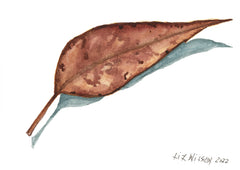


Leaf
Available in: Unframed - Rolled Canvas, Stretched-Ready To Hang, Natural-Framed, Gold-Framed, Black-Framed, White-Framed, Brown-Framed.
Read more about this artwork
Available professionally framed in White, Black, Natural, Gold, or Brown timber frames, or as a Stretched Ready-to-Hang Canvas.
Contemplative watercolor study painted in 2022. I was moved by the quiet dignity of a fallen eucalyptus leaf in its final stage of transformation, curled and weathered yet still beautiful. Using delicate watercolor washes in burnt sienna, raw umber, and soft grey-blue, I captured the papery texture, subtle spotting, and gentle curl that speaks to the leaf's journey from vibrant green canopy dweller to earth-bound treasure. The minimalist composition against white space honors the subject's simplicity, inviting meditation on the poetry of decay and the graceful acceptance of life's natural cycles.
Did you know?
Leaves are nature's solar panels, performing photosynthesis to convert sunlight into energy that sustains virtually all life on Earth. A single tree can have hundreds of thousands of leaves, each one breathing, transpiring water, and creating oxygen. Australian eucalyptus leaves contain aromatic oils that make them highly flammable yet provide medicinal properties used for millennia. When leaves fall, they're not dying but completing their purpose, returning nutrients to soil in a perfect example of circular economy millennia before humans coined the term.
The falling leaf has inspired poets, philosophers, and artists across cultures as the ultimate symbol of impermanence, natural cycles, and graceful letting go. In Japanese aesthetics, "wabi-sabi" celebrates the beauty of imperfection and transience, with fallen autumn leaves exemplifying this philosophy perfectly. Buddhist teachings use falling leaves to illustrate non-attachment and the acceptance of change. The leaf's journey from bud to full glory to weathered beauty teaches that every stage has its own perfection, that letting go is natural, and that what appears as ending is actually transformation into something new.
Symbolism includes: Impermanence, natural cycles, graceful aging, transformation, letting go, wabi-sabi beauty, life's stages, returning to earth, acceptance, and perfection in each moment.
As Spirit Guide: Encourages accepting life's natural transitions with grace, recognizing beauty in every stage including decline, and understanding that letting go nourishes new growth.
In Dreams: Suggests transitions, acceptance of aging or endings, need to let go gracefully, or recognition that your current chapter's completion will nourish what comes next.
Vendor:
Liz Wilson
Availability:
In stock
- $335.00
- $335.00
- Unit price
- per
Subtotal:
$335.00
Couldn't load pickup availability

Description
xAvailable professionally framed in White, Black, Natural, Gold, or Brown timber frames, or as a Stretched Ready-to-Hang Canvas.
Contemplative watercolor study painted in 2022. I was moved by the quiet dignity of a fallen eucalyptus leaf in its final stage of transformation, curled and weathered yet still beautiful. Using delicate watercolor washes in burnt sienna, raw umber, and soft grey-blue, I captured the papery texture, subtle spotting, and gentle curl that speaks to the leaf's journey from vibrant green canopy dweller to earth-bound treasure. The minimalist composition against white space honors the subject's simplicity, inviting meditation on the poetry of decay and the graceful acceptance of life's natural cycles.
Did you know?
Leaves are nature's solar panels, performing photosynthesis to convert sunlight into energy that sustains virtually all life on Earth. A single tree can have hundreds of thousands of leaves, each one breathing, transpiring water, and creating oxygen. Australian eucalyptus leaves contain aromatic oils that make them highly flammable yet provide medicinal properties used for millennia. When leaves fall, they're not dying but completing their purpose, returning nutrients to soil in a perfect example of circular economy millennia before humans coined the term.
The falling leaf has inspired poets, philosophers, and artists across cultures as the ultimate symbol of impermanence, natural cycles, and graceful letting go. In Japanese aesthetics, "wabi-sabi" celebrates the beauty of imperfection and transience, with fallen autumn leaves exemplifying this philosophy perfectly. Buddhist teachings use falling leaves to illustrate non-attachment and the acceptance of change. The leaf's journey from bud to full glory to weathered beauty teaches that every stage has its own perfection, that letting go is natural, and that what appears as ending is actually transformation into something new.
Symbolism includes: Impermanence, natural cycles, graceful aging, transformation, letting go, wabi-sabi beauty, life's stages, returning to earth, acceptance, and perfection in each moment.
As Spirit Guide: Encourages accepting life's natural transitions with grace, recognizing beauty in every stage including decline, and understanding that letting go nourishes new growth.
In Dreams: Suggests transitions, acceptance of aging or endings, need to let go gracefully, or recognition that your current chapter's completion will nourish what comes next.
Additional Information
xChoose from the sizes and finishes listed for this artwork. The price updates to match your selection.
Check the selected dimensions before ordering. Room settings are illustrative; colour can vary between screens.
Shipping & Return
xFor delivery questions, please contact Liz before ordering.
Read our Returns & Exchanges policy.
Related Products
Recently Viewed Products
- Choosing a selection results in a full page refresh.


